Rhythm
Growth hormone between the pulses
A raised background and a continuing rhythm can occupy the same record. That combination revised my first impression of a long-acting stimulus.
Participants and observations
The CJC-1295 pulse study enrolled healthy men aged 20–40. One week after a single administration, basal or trough growth hormone was approximately 7.5-fold higher, mean GH was about 46% higher and IGF-1 about 45% higher. The frequency and magnitude of pulsatile GH secretion were unaltered.
The basal value is the background between bursts. A mean folds the observation period into an average. The pulse measurements describe a rhythm across that period. The average had too much of the stage in my first impression; the background and the bursts need room beside it.
Background and pulse rhythm
The authors reported that pulsatile secretion persisted during the continuous stimulation produced by the long-acting analog. That finding changed my expectation. I had pictured prolonged stimulation as something that would iron the record flat. Here, the raised background coexisted with the measured pulse pattern.
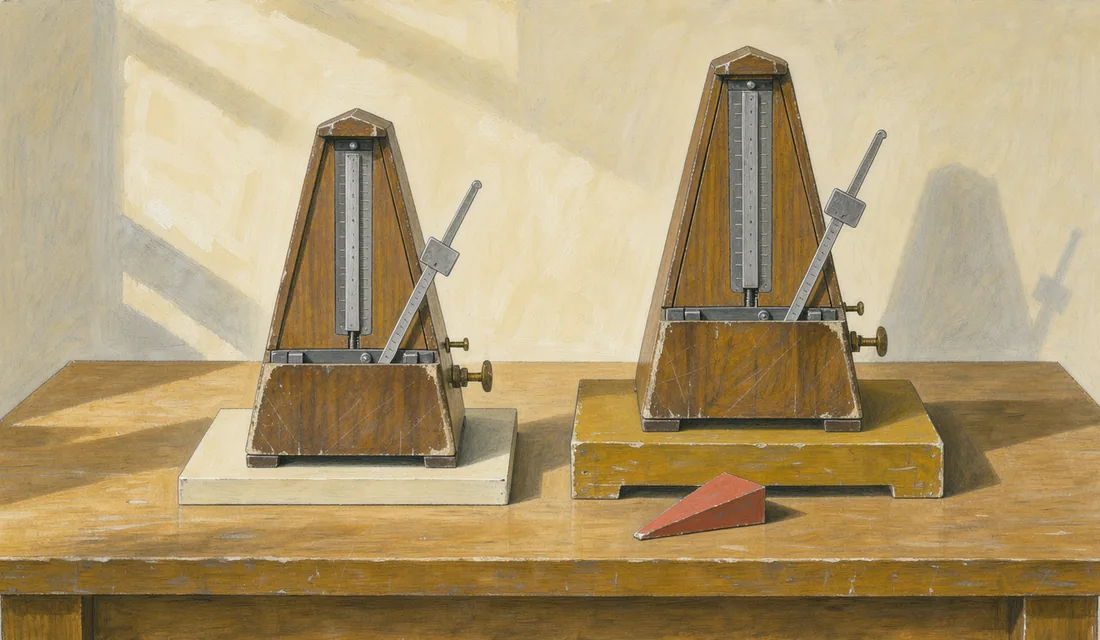
The metronomes in the plate are an analogy: matching rhythms stand on different bases. They cannot reproduce the study's measurements. I like the image because it lets the background and the rhythm remain visible together without awarding either one a health benefit.
To my mind, preserving the rhythm answers a precise physiological question. It leaves a clinical question open: how does that whole altered record relate to an outcome a person would value? Calling the pattern preserved still leaves the higher background to account for.
The fading stimulus
The reported pulse observations were made one week after administration in healthy men aged 20–40. That timing suggests a more specific question to me: what would a record spanning the return toward the original state look like?
I would ask for observations across that transition. Would the background settle first? Would the pulse frequency and magnitude remain steady as the stimulus faded? Those are proposed questions, not results supplied by this experiment. I prefer their motion across time to the tidiness of an isolated average.
The GHRH-knockout mouse experiment puts timing under a different kind of pressure. There, the interval between administrations mattered to growth itself. It is a useful next stop because the outcome changes along with the species.